
5 Ways to Beat Pre-Game Jitters & Perform Under Pressure
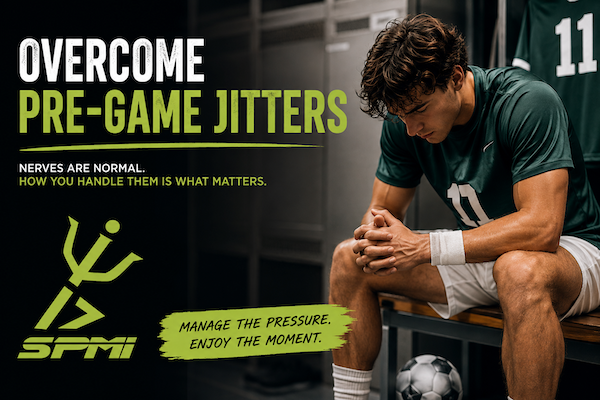
Pre-game jitters are one of the most common struggles we see among athletes when they begin mental training with SPMI. Whether an athlete is preparing for a championship match, an important tournament, a college showcase, or simply the next game of the season, nervousness can quickly take over.
The heart starts racing. The stomach feels unsettled. Muscles tighten. Thoughts begin moving faster. Suddenly, instead of thinking about competing, the athlete is thinking, What if I mess up? What if I lose? What if I disappoint everyone?
At SPMI, our goal is not necessarily to eliminate pressure. We help athletes learn how to manage pressure and eventually even enjoy it. Pressure is part of competition. The athletes who perform consistently are often not the ones who never get nervous. They are the ones who have learned what to do when those nerves arrive.
Why Do Athletes Get Pre-Game Jitters?
Pre-competition anxiety has both mental and physical components. Mentally, athletes may experience worry, doubt, overthinking, or fear of failure. Physically, nervousness can produce an increased heart rate, faster breathing, muscle tension, sweating, or the familiar feeling of “butterflies” in the stomach. Research has identified precompetitive anxiety and self-confidence as important psychological factors associated with athletic performance.
But here is an important distinction: feeling nervous does not automatically mean you are unprepared.
Your body is preparing to perform. Increased energy and alertness can actually be useful. The problem often begins when athletes interpret those sensations negatively.
Instead of thinking, My body is getting ready to compete, they think, I'm nervous. Something is wrong.
Mental training can help change that response.
1. Stop Fighting the Nerves
One of the biggest mistakes athletes make is trying desperately not to feel nervous.
They tell themselves:
“I need to calm down.”
“Why am I so nervous?”
“I shouldn't feel this way.”
This can create another layer of anxiety because now the athlete is nervous about being nervous.
Instead, accept the feeling.
Tell yourself:
“I'm supposed to feel something. This matters to me.”
The objective is not always to become completely relaxed. In many sports, being too relaxed can actually work against performance. The goal is to find the level of activation where you feel energized, focused, confident, and ready to compete.
Learn to view those butterflies as energy rather than danger.
2. Control Your Breathing
When athletes become nervous, their breathing often becomes faster and shallower. Deliberately slowing the breath can help regulate the body's response to pressure.
Research supports slow-paced breathing as a useful psychological strategy for athletes. A 2026 season-long study involving adolescent American football players used slow-paced breathing as part of a pre-competition intervention and found reductions in cognitive anxiety over the season along with greater stability in self-confidence.
Try taking several controlled breaths before competition. Breathe slowly into the diaphragm and make the exhale slightly longer than the inhale.
More importantly, practice your breathing during training.
Mental skills work like physical skills. You don't want the championship game to be the first time you attempt to use them.
3. Focus on What You Can Control
Pre-game anxiety frequently comes from thinking too far ahead.
What if I lose?
What will my coach think?
What will my parents think?
What if I don't play well?
Notice that almost all of these thoughts are focused on outcomes.
Instead, bring your attention back to controllables.
Ask yourself:
What do I need to do right now?
Your answer might be:
- Move my feet.
- Communicate.
- Stay aggressive.
- Trust my training.
- Watch the ball.
- Compete one point or play at a time.
Pressure becomes much easier to manage when athletes shrink the competition from one enormous event into a series of small, controllable actions.
4. Develop a Consistent Pre-Game Routine
Athletes should not leave their mental preparation to chance.
Create a routine.
Research in sport psychology suggests that preparatory and pre-performance routines can help athletes regulate emotions, direct attention, reduce distractions, and reach an appropriate level of activation before performing. These routines can incorporate breathing, imagery, concentration strategies, and positive self-talk.
Your routine might include five minutes of controlled breathing, visualization of successful execution, a few specific confidence statements, music, and two or three performance cues.
The exact routine matters less than its consistency.
Eventually, your brain begins associating the routine with competition: It's time to perform.
5. Visualize Yourself Handling Pressure
Visualization should not only involve imagining everything going perfectly.
Visualize yourself responding well when things don't go perfectly.
Imagine falling behind and remaining composed. Picture making a mistake and immediately resetting. See yourself walking into an intimidating environment and competing aggressively.
Research has identified imagery as one strategy that may help athletes protect performance in pressure situations.
This teaches an important lesson:
Confidence isn't believing nothing will go wrong. Confidence is believing you can handle it when something does.
Learn to Enjoy the Moment
Pressure usually means something important is happening.
Instead of spending your athletic career wishing the nervousness would disappear, learn how to use it.
The butterflies may never completely go away — and that's okay.
With mental training, athletes can learn to recognize those sensations, control their breathing, redirect their focus, trust their preparation, and eventually walk into pressure situations thinking:
“This is what I trained for.”
At SPMI, we've helped thousands of athletes develop the mental skills necessary to manage pressure, build confidence, improve focus, control emotions, and perform more consistently when competition matters most.
To learn more or get started, sign up for a FREE 15-minute consultation with SPMI below.