
Don't Let it Snowball
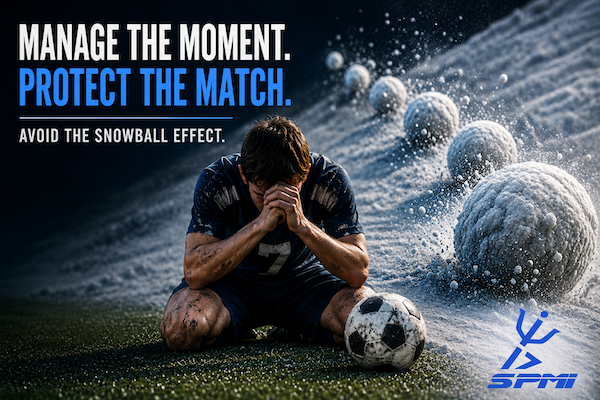
Mistakes are unavoidable in sports. A tennis player double faults. A basketball player turns the ball over. A soccer player misses an open shot. A gymnast falls from the beam. A quarterback throws an interception.
The mistake itself is rarely the biggest problem.
What often causes the most damage is what happens mentally after the mistake.
At SPMI, we frequently work with athletes who struggle to recover after something goes wrong. One mistake becomes two. Two become three. Frustration increases, confidence drops, and suddenly the athlete feels as though the entire competition is slipping away.
This is what we can call the snowball effect.
Why Mistakes Snowball
Imagine a small snowball rolling downhill. At first, it is manageable. But as it continues rolling, it collects more snow and becomes increasingly difficult to stop.
Mistakes can work the same way.
An athlete makes an error and immediately thinks:
"I can't believe I did that."
That thought becomes:
"I'm playing terrible."
Then:
"I'm going to lose."
The athlete is no longer responding only to the original mistake. Now they are responding to the emotional reaction created by the mistake.
Attention shifts away from the present moment. Muscles may become tighter. Decision making becomes rushed. Confidence decreases. The athlete begins trying harder to avoid another mistake rather than simply competing.
Ironically, being afraid of the next mistake can make another mistake more likely.
Research supports the importance of how athletes respond to failure. Studies examining self compassion in athletes have found that athletes with greater self compassion tend to demonstrate fewer maladaptive thoughts and negative emotional reactions when confronting sport failure. One study involving university and national level athletes found that greater self compassion predicted more adaptive behavioral reactions and fewer negative thoughts following recalled performance failure.
Another study found that athletes higher in self compassion reported less self criticism and less concern over mistakes. Importantly, self compassion does not mean ignoring mistakes or lowering standards. It means responding to the mistake productively enough to learn from it without allowing it to control what happens next.
So how can athletes stop the snowball?
1. Develop a Mistake Recovery Routine
Athletes should have a predetermined response to mistakes.
Instead of deciding what to do while frustrated, create a simple routine beforehand:
Recognize. Reset. Refocus.
Recognize what happened without exaggerating it.
"I missed the shot."
Reset mentally and physically. Take a controlled breath, relax the shoulders, adjust equipment, or use another physical cue.
Then refocus on one specific task:
"Move my feet."
"Watch the ball."
"Next possession."
The routine should take only a few seconds. The objective isn't to erase the mistake. It is to prevent the mistake from stealing the next play.
2. Separate the Mistake From Your Identity
There is an enormous psychological difference between:
"I made a bad play."
and
"I'm playing terrible."
The first describes an event. The second labels the athlete.
Athletes should practice using objective language following mistakes. Instead of saying, "I'm terrible at this," identify exactly what happened and what can be corrected.
Mistakes provide information. They don't define ability.
3. Use the Next Play Mentality
Athletes cannot change what happened 30 seconds ago. They can influence what happens during the next 30 seconds.
After a mistake, ask:
"What does the next play require from me?"
This question moves attention away from emotion and toward action.
Research involving 90 college athletes found that greater self compassion predicted better recovery from negative emotions after athletes recalled failure experiences. This ability to recover emotionally is particularly important because athletes often have very little time between one performance moment and the next.
Elite competitors are not necessarily athletes who make fewer mistakes. Often, they are athletes who recover faster from them.
4. Stop Chasing the Mistake
After an error, athletes sometimes try to immediately compensate.
A basketball player misses an easy shot and forces the next one. A tennis player misses a routine forehand and goes for an unnecessary winner on the next point.
Don't try to "win back" the mistake.
Return to your normal strategy.
One mistake does not require a spectacular response. It requires a disciplined one.
What Parents Can Do
Parents can unintentionally make mistakes feel much larger than they are.
After competition, immediately analyzing every error can reinforce the athlete's belief that mistakes are catastrophic. Instead, parents should first provide emotional stability.
Try:
"I loved watching you compete."
"That was a tough moment. I liked how you kept fighting."
Later, when emotions have settled, mistakes can become learning opportunities.
Parents should also praise recovery, not just results. If your athlete makes a major mistake and responds well on the next play, recognize it. You're teaching them that mental recovery is a skill worth developing.
Don't Let One Moment Become the Whole Performance
Every athlete makes mistakes.
The goal of mental training isn't to create an athlete who never becomes frustrated, disappointed, or upset. The goal is to develop an athlete who can experience those emotions without allowing them to dictate the next play.
Make the mistake.
Learn from it.
Reset.
Then compete again.
Because one mistake rarely destroys a performance.
It's the snowball that does.
If your athlete struggles with mistakes, frustration, confidence, or recovering mentally during competition, SPMI provides individualized mental training designed to help athletes develop stronger and more consistent competitive mindsets.
Schedule a free 15 minute consultation at SPMIPLUS.COM.