
Knowing When an Athlete Is Ready For The Next Level
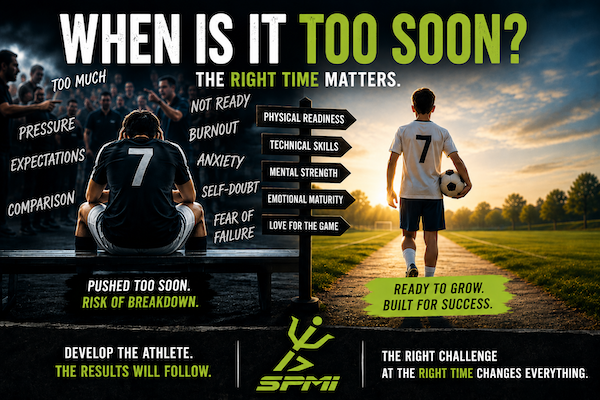
Every parent wants to see their athlete progress. When a young athlete begins outperforming their competition, it can be tempting to immediately move them to a stronger team, older age group, elite academy, national circuit, or even the professional level.
But just because an athlete can compete at the next level physically does not necessarily mean they are ready for it mentally.
At SPMI, we often work with athletes who possess tremendous physical talent but are struggling with the psychological demands surrounding that talent. Sometimes the challenge isn't that the athlete lacks ability. The athlete may simply have been asked to handle more pressure, expectations, training, travel, or competition than they were mentally prepared to manage.
Development shouldn't become a race.
The Danger of Too Much, Too Soon
Moving an athlete up can be beneficial when the challenge matches their development. Stronger competition can expose weaknesses, accelerate learning, and teach athletes how to become comfortable being uncomfortable.
But there is an important difference between challenging an athlete and overwhelming an athlete.
Research supports this distinction. The American Academy of Pediatrics has warned that intensive training, early specialization, excessive pressure, and high training volumes can contribute to burnout and athletes eventually leaving their sport. Burnout can involve emotional and physical exhaustion, reduced feelings of accomplishment, and eventually devaluing a sport the athlete once loved.
Sometimes adults become so focused on where an athlete could eventually go that they stop paying attention to where the athlete is right now.
Simone Biles: When Even the Best Need to Stop
Simone Biles provides an important example, although we should be careful not to claim that she was simply "pushed too early." Biles was extraordinarily successful from a young age and became one of the greatest gymnasts in history.
However, her experience demonstrates what can happen when enormous expectations and elite competition collide with an athlete's mental well-being.
At the Tokyo Olympics in 2021, Biles experienced what gymnasts call the "twisties," a dangerous mental block in which a gymnast can lose awareness of their position while rotating through the air. She withdrew from several Olympic events while citing mental-health and safety concerns.
Interestingly, Biles' former coach has said she experienced a similar problem before the 2016 Olympics. Rather than forcing her through it, her coach reportedly allowed her time to rebuild her comfort with twisting.
Biles eventually returned after Tokyo and again reached the highest level of the sport.
Her story demonstrates something every young athlete and parent should understand:
Sometimes slowing down is part of moving forward.
How Do You Know an Athlete Is Ready?
Readiness should involve more than statistics, rankings, speed, strength, or technical ability.
Before moving an athlete up, consider four areas:
Physical readiness: Can the athlete safely handle the speed, strength, workload, and physical demands of the next level?
Technical readiness: Does the athlete have the fundamental skills necessary to compete without constantly feeling overwhelmed?
Emotional readiness: How does the athlete respond to mistakes, losses, criticism, adversity, and increased expectations?
Motivational readiness: Most importantly, does the athlete actually want this?
Parents should be especially careful with the last question.
A young athlete saying, "I'll do it if you want me to" is very different from saying, "I want to see how good I can become."
The athlete needs ownership of the journey.
1. Challenge Them Gradually
Development doesn't have to mean immediately jumping from one level to another permanently.
Allow athletes to sample the next level.
Practice with an older team. Enter a stronger tournament occasionally. Attend an elite camp. Train with better athletes.
Then evaluate the response.
The ideal challenge stretches an athlete without destroying their confidence.
2. Develop Mental Skills Before They Are Needed
Parents and coaches often invest heavily in technical development and wait until an athlete struggles psychologically before considering mental training.
Mental preparation should begin before the pressure arrives.
Athletes moving into higher levels should learn skills such as emotional control, confidence building, visualization, breathing techniques, positive self-talk, concentration, goal setting, and effective responses to mistakes.
Mental skills are part of preparation, just like strength, conditioning, and technique.
3. Watch for Changes in Behavior
Parents should pay attention when an athlete who once loved competing suddenly begins dreading practices or competitions.
Potential warning signs can include:
- Constant anxiety surrounding competition
- Loss of confidence
- Irritability
- Fear of making mistakes
- Declining motivation
- Physical or emotional exhaustion
- Wanting to avoid practices or competitions
- No longer enjoying the sport
One bad week doesn't necessarily mean an athlete needs to move down. But a consistent pattern deserves attention.
4. Don't Make Your Athlete's Identity Their Results
As athletes become more successful, their sport can gradually become their entire identity.
"I'm the tennis player."
"I'm the quarterback."
"I'm the gymnast."
Then losing doesn't simply mean I played badly.
It begins to feel like I am not good enough.
Parents can help by consistently reinforcing character, effort, discipline, courage, preparation, and growth rather than making rankings and results the primary source of praise.
The Right Level Is the Level Where Growth Can Continue
The goal shouldn't be to get your athlete to the highest level as quickly as possible.
The goal should be to help them reach their potential while developing the physical and psychological foundation necessary to stay there.
Sometimes athletes need to be pushed.
Sometimes they need to be challenged.
And sometimes the smartest developmental decision is to give them more time.
There is no prize for getting there first.
Develop the athlete before demanding the performance.
At SPMI, we help athletes develop the confidence, focus, emotional control, resilience, and mental skills necessary to handle the increasing demands of competitive sports.
To learn more or get started, sign up for a FREE 15-minute consultation with SPMI below.